Have you ever walked into a store to buy one item and left with five? Or opened an online shopping app for a quick browse and ended up placing an order you hadn’t planned to make?
If so, you’re not alone.
Every day, millions of people spend money on products and services they don’t truly need. From impulse purchases and luxury upgrades to subscription services we barely use, unnecessary spending has become a common part of modern life. While it might seem like a lack of self-control, the reality is far more complex.
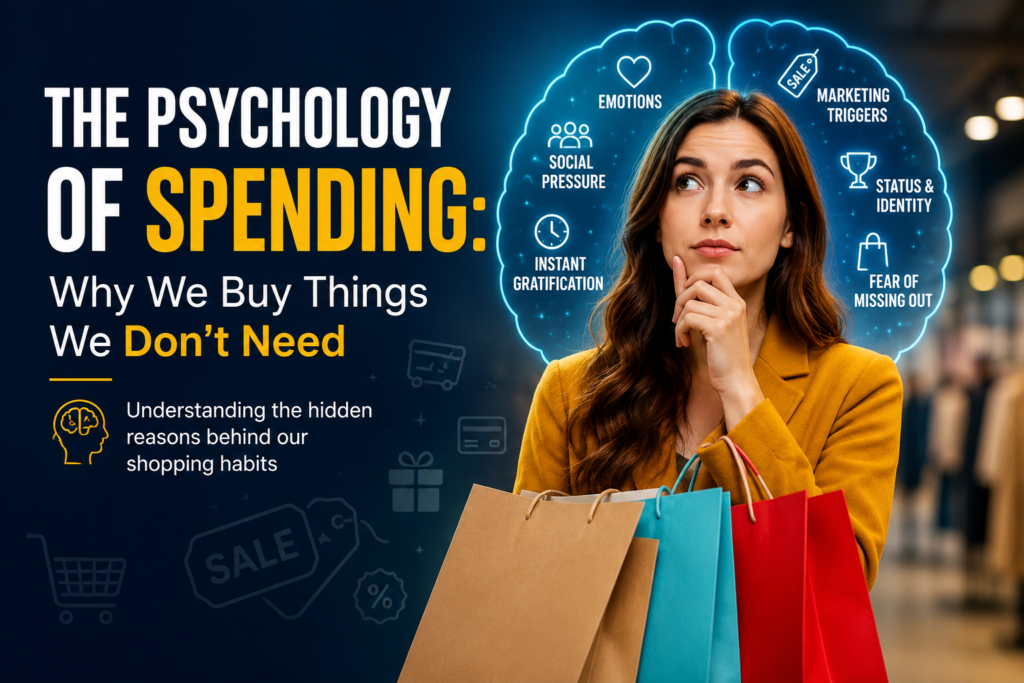
Human spending behavior is deeply rooted in psychology. Our purchasing decisions are influenced by emotions, social pressures, cognitive biases, marketing tactics, and even our evolutionary instincts. Understanding why we buy things we don’t need can help us make smarter financial decisions, reduce impulse spending, and build healthier relationships with money.
In this article, we’ll explore the fascinating psychology behind spending habits, uncover the hidden forces driving consumer behavior, and learn practical strategies to regain control over our financial choices.
Understanding the Difference Between Needs and Wants
Before diving into spending psychology, it’s important to distinguish between needs and wants.
Needs
Needs are essential for survival and basic functioning. These include:
- Food
- Shelter
- Healthcare
- Transportation
- Basic clothing
- Utilities
Wants
Wants are things that enhance comfort, convenience, status, or enjoyment but aren’t necessary for survival.
Examples include:
- Designer clothing
- Latest smartphones
- Luxury vacations
- Premium streaming subscriptions
- High-end vehicles
The challenge is that our brains often blur the line between needs and wants. A new phone may feel necessary even when our current one works perfectly. This psychological distortion plays a major role in modern consumer behavior.
The Emotional Side of Spending
One of the biggest reasons people overspend is emotional purchasing.
Contrary to popular belief, humans are not purely rational decision-makers. Research consistently shows that emotions drive a large percentage of purchasing decisions.
Retail Therapy: Buying to Feel Better
Many people shop when experiencing:
- Stress
- Anxiety
- Loneliness
- Boredom
- Sadness
- Frustration
Purchasing something new temporarily boosts mood by triggering the release of dopamine, a neurotransmitter associated with pleasure and reward.
The excitement often comes before the purchase rather than after it.
This is why:
- Adding items to an online cart feels satisfying.
- Waiting for delivery feels exciting.
- Unboxing creates anticipation.
However, the emotional boost is usually temporary, leading people to seek another purchase later.
This cycle can create unhealthy spending habits over time.
The Dopamine Effect: Why Shopping Feels Addictive
The brain’s reward system plays a major role in consumer behavior.
Whenever we anticipate a reward, dopamine levels increase.
Interestingly, dopamine isn’t just released when we receive something—it spikes when we expect something positive.
This explains why:
- Flash sales feel exciting.
- Limited-time offers create urgency.
- Online auctions become addictive.
- Mystery boxes attract buyers.
Retailers understand this psychological mechanism extremely well and design shopping experiences around it.
Every notification, discount alert, and promotional email is crafted to stimulate anticipation and trigger action.
Social Status and the Desire to Belong
Humans are social creatures.
For thousands of years, survival depended on being accepted by a group. As a result, our brains remain highly sensitive to social approval.
Many purchases are driven by the desire to:
- Fit in
- Impress others
- Signal success
- Gain respect
- Increase social standing
Status Spending
Status spending occurs when people buy products primarily to communicate identity or achievement.
Examples include:
- Luxury watches
- Designer handbags
- Premium vehicles
- High-end electronics
- Exclusive memberships
The product itself may not provide significantly greater utility, but it provides social value.
Psychologists call this signaling behavior.
We often buy products not just for what they do but for what they say about us.
The Power of Social Comparison
One of the strongest spending triggers is comparison.
People naturally evaluate themselves against others.
Today, social media has amplified this tendency dramatically.
Platforms showcase:
- Luxury vacations
- New homes
- Expensive cars
- Fashion purchases
- Restaurant experiences
While viewers see only curated highlights, they often compare those moments to their everyday reality.
This creates what psychologists call relative deprivation—the feeling that others have more, even when our own needs are fully met.
As a result, people spend money attempting to close perceived social gaps.
Fear of Missing Out (FOMO)
FOMO has become one of the most powerful psychological drivers of spending.
The fear that others are enjoying opportunities we’re missing can lead to impulsive purchases.
Common examples include:
- Limited edition products
- Exclusive memberships
- Flash sales
- Event tickets
- Trending gadgets
Marketers frequently leverage FOMO through phrases such as:
- “Only 2 left in stock”
- “Sale ends tonight”
- “Limited-time offer”
- “Exclusive access”
These messages create urgency and reduce the time consumers spend thinking critically about purchases.
How Marketing Manipulates Buying Decisions
Modern marketing is built on psychology.
Businesses invest billions of dollars understanding how consumers think, feel, and behave.
Let’s examine some of the most effective psychological tactics.
Anchoring
Anchoring occurs when people rely heavily on the first price they see.
Example:
A jacket originally priced at $300 is discounted to $150.
Even if $150 is still expensive, it feels like a bargain because the original price acts as an anchor.
Consumers focus on the perceived savings rather than the actual value.
Decoy Pricing
Businesses often introduce a third option to influence choices.
For example:
- Basic Plan: $10
- Premium Plan: $25
- Deluxe Plan: $27
The Deluxe Plan makes the Premium Plan appear more attractive, even if consumers never intended to spend that much.
The third option changes perception rather than value.
Scarcity
People place higher value on things that appear rare.
Psychologically, scarcity signals importance.
Examples include:
- Limited stock alerts
- Exclusive releases
- Countdown timers
- Invite-only products
The fear of losing an opportunity often outweighs rational analysis.
Free Offers
Humans love the word “free.”
A free bonus can dramatically increase purchase rates, even when the overall deal isn’t particularly valuable.
Examples:
- Free shipping
- Buy one get one free
- Free trial subscriptions
- Complimentary gifts
The emotional impact of receiving something for free often overrides logical calculations.
Impulse Buying and Instant Gratification
The human brain tends to prioritize immediate rewards over future benefits.
This tendency is known as present bias.
Consider two options:
- Save $100 for future financial security.
- Spend $100 today on something enjoyable.
Many people choose immediate pleasure because future benefits feel distant and abstract.
This explains why:
- Credit card debt accumulates.
- Savings goals get delayed.
- Impulse purchases happen frequently.
The brain naturally discounts future rewards in favor of present satisfaction.
The Role of Credit Cards in Overspending
Spending cash feels different from swiping a card.
Psychologists call this the pain of paying.
When using physical cash:
- Money visibly leaves your possession.
- Spending feels more tangible.
- Purchases receive greater scrutiny.
With digital payments:
- Transactions feel effortless.
- Spending becomes psychologically detached.
- Financial consequences feel delayed.
Studies consistently show that consumers often spend more when using credit cards compared to cash.
Digital payment systems reduce the emotional friction associated with spending.
Why Discounts Feel Irresistible
Sales activate several psychological triggers simultaneously.
They create:
- Excitement
- Urgency
- Fear of missing out
- Perceived savings
Consumers often believe they’re saving money when purchasing discounted items.
However, if the purchase wasn’t needed in the first place, money wasn’t actually saved—it was spent.
This mental trap explains why people frequently buy unnecessary items during major shopping events like:
- Black Friday
- Cyber Monday
- Seasonal sales
- Clearance events
The focus shifts from spending to saving, even when no real need exists.
Identity-Based Spending
Many purchases reflect who we want to become rather than who we are today.
People buy:
- Fitness equipment to become healthier.
- Books to become smarter.
- Business courses to become entrepreneurs.
- Kitchen gadgets to become better cooks.
These purchases often represent aspirations.
Unfortunately, buying the tool doesn’t automatically create the habit.
As a result, many products remain unused because consumers purchased an identity rather than a necessity.
Childhood Influences on Spending Behavior
Financial habits often develop early in life.
People who grew up in different economic environments may develop very different relationships with money.
Scarcity Mindset
Individuals raised in financially insecure households may:
- Hoard possessions
- Overspend when money becomes available
- Fear running out of resources
Abundance Mindset
Those raised with financial stability may:
- Feel more comfortable spending
- Take greater financial risks
- Focus less on immediate security
Early experiences shape beliefs about money that can persist throughout adulthood.
The Impact of Advertising and Consumer Culture
Modern consumers encounter thousands of marketing messages every day.
These messages often imply that happiness, success, attractiveness, or confidence can be purchased.
Common advertising themes include:
- “You deserve this.”
- “Upgrade your lifestyle.”
- “Be your best self.”
- “Stand out from the crowd.”
Over time, repeated exposure creates associations between spending and personal fulfillment.
While products can improve convenience and enjoyment, long-term happiness typically depends more on relationships, health, purpose, and meaningful experiences.
Why Online Shopping Makes Overspending Easier
E-commerce platforms are designed for convenience.
Features such as:
- One-click purchasing
- Saved payment methods
- Personalized recommendations
- Instant checkout
- Push notifications
remove barriers that once slowed purchasing decisions.
Algorithms continuously learn user preferences and present highly relevant products at precisely the right moment.
The easier it becomes to spend money, the more discipline consumers must exercise.
Practical Strategies to Control Unnecessary Spending
Understanding spending psychology is only useful if it leads to better financial decisions.
Here are practical methods to reduce impulse purchases.
Implement the 24-Hour Rule
Before buying non-essential items, wait 24 hours.
For larger purchases, consider waiting:
- 48 hours
- One week
- One month
The emotional urge often fades with time.
Create a Spending Plan
Budgeting isn’t about restriction.
It’s about intentional spending.
Allocate money toward:
- Essentials
- Savings
- Investments
- Enjoyment
Knowing where money should go reduces impulsive decisions.
Unsubscribe from Marketing Emails
Many purchases occur because consumers are constantly exposed to promotions.
Reducing exposure lowers temptation.
Consider unsubscribing from:
- Retail newsletters
- Promotional alerts
- Flash sale notifications
Identify Emotional Triggers
Ask yourself:
- Am I bored?
- Am I stressed?
- Am I trying to impress someone?
- Am I seeking comfort?
Recognizing emotional triggers helps separate feelings from financial decisions.
Focus on Long-Term Goals
Visual reminders of financial goals can strengthen self-control.
Examples include:
- Emergency funds
- Home ownership
- Debt freedom
- Retirement savings
- Travel goals
The more meaningful the goal, the easier it becomes to resist unnecessary spending.
Track Every Purchase
Awareness often changes behavior.
Recording purchases helps identify patterns such as:
- Emotional spending
- Subscription waste
- Impulse buying
- Frequent small expenses
Many people are surprised by how much they spend on seemingly insignificant purchases.
The Bigger Picture: Spending Is About Psychology, Not Just Money
Money decisions are rarely just financial decisions.
They involve:
- Emotions
- Identity
- Habits
- Social influences
- Cognitive biases
- Cultural expectations
Understanding these factors doesn’t mean you’ll never make impulse purchases again. However, it gives you the awareness needed to make more intentional choices.
The goal isn’t to eliminate spending on enjoyment or luxury. Instead, it’s to ensure your purchases align with your values, priorities, and long-term goals.
Conclusion
The psychology of spending reveals that humans are not purely rational consumers. We buy things we don’t need because our decisions are influenced by emotional rewards, social comparison, marketing tactics, status signaling, dopamine-driven anticipation, and a desire for immediate gratification.
Retailers and advertisers understand these psychological triggers exceptionally well, often designing experiences that encourage spending without careful reflection.
The good news is that awareness creates power.
When you understand why you’re tempted to buy, you gain the ability to pause, evaluate, and choose more consciously. Over time, this awareness can lead to healthier financial habits, greater savings, reduced stress, and a stronger sense of control over your money.
Ultimately, the most valuable purchase decision isn’t about finding the best deal—it’s about ensuring that what you buy genuinely adds value to your life.