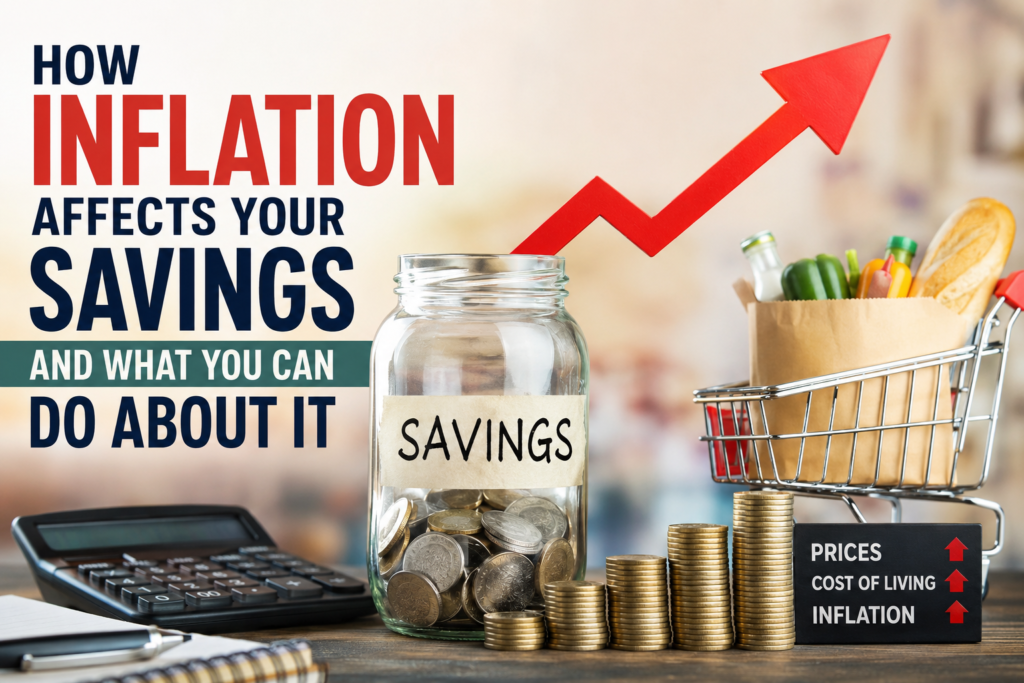
Imagine putting money aside every month, watching your savings account balance grow, and feeling confident that you’re building a secure financial future. Then, a few years later, you discover that despite having more money in your account, your savings actually buy less than they did before. This is the hidden impact of inflation.
Inflation is one of the most important yet misunderstood forces affecting personal finance. It quietly reduces the purchasing power of your money over time, making everyday goods, services, housing, healthcare, and education more expensive. While inflation is a natural part of most economies, failing to account for it can significantly undermine your long-term financial goals.
Understanding how inflation works—and how to protect your savings against it—is essential for anyone who wants to build wealth, maintain financial security, and achieve long-term financial independence.
In this guide, we’ll explore how inflation affects savings, why traditional savings accounts often struggle to keep pace, and practical strategies you can use to preserve and grow your purchasing power.
What Is Inflation?
Inflation refers to the general increase in prices across an economy over time. As prices rise, each unit of currency buys fewer goods and services.
For example:
- A loaf of bread that costs $2 today may cost $2.20 next year.
- A car priced at $25,000 today might cost $27,000 in a few years.
- Rent, healthcare, and education expenses often rise steadily over time.
When inflation occurs, the value of money decreases in terms of what it can purchase.
Simple Example
Suppose you have $10,000 in savings.
If annual inflation is 5%, goods and services that cost $10,000 today will cost approximately:
- $10,500 next year
- $11,025 after two years
- $12,763 after five years
Even though your account still shows $10,000, its real purchasing power has declined significantly.
This is why inflation is often called the “silent wealth killer.”
How Inflation Impacts Your Savings
1. Reduced Purchasing Power
The most direct impact of inflation is the erosion of purchasing power.
If your money earns less than the inflation rate, you’re effectively losing value every year.
For example:
| Savings Growth | Inflation Rate | Real Result |
|---|---|---|
| 2% | 5% | -3% purchasing power |
| 3% | 6% | -3% purchasing power |
| 1% | 4% | -3% purchasing power |
Many people focus only on the growth of their account balance rather than what that balance can actually buy.
The goal isn’t merely increasing the number of dollars you own—it’s maintaining or increasing purchasing power.
2. Lower Real Returns
Financial professionals often distinguish between:
- Nominal return (what your account earns)
- Real return (what you earn after inflation)
For example:
If your savings account earns 4% annually and inflation is 6%:
Real Return = 4% – 6% = -2%
Even though your account balance increases, your purchasing power declines.
This concept is critical when evaluating investment and savings options.
3. Increased Cost of Living
Inflation affects nearly every aspect of daily life, including:
- Housing
- Utilities
- Food
- Transportation
- Insurance
- Healthcare
- Education
As expenses rise, households may find it harder to save.
Many families discover that their income increases fail to keep pace with rising living costs, reducing the amount available for savings and investments.
4. Retirement Savings Challenges
Inflation poses a significant threat to retirees.
Many people estimate retirement expenses using today’s prices rather than future costs.
Consider this example:
If you need $50,000 annually today and inflation averages 3%:
After 20 years, you’ll need approximately $90,000 annually to maintain the same lifestyle.
Without inflation-adjusted planning, retirement savings can fall short much sooner than expected.
Why Keeping Money in Cash Can Be Risky
Many people view cash as completely safe because its value doesn’t fluctuate daily like stocks or real estate.
However, cash carries a different kind of risk:
Inflation Risk
When inflation exceeds the interest earned on cash, your money loses purchasing power.
For example:
- Savings account yield: 2%
- Inflation rate: 5%
After one year:
- Account balance grows to $10,200
- Purchasing power falls to the equivalent of about $9,714 in today’s dollars
This loss often goes unnoticed because the account balance still increases.
Historical Perspective on Inflation
Inflation rates vary over time and across countries.
Historically, many developed economies have experienced average annual inflation rates between 2% and 3%.
However, certain periods have seen significantly higher inflation due to:
- Supply chain disruptions
- Economic crises
- Rapid money supply growth
- Energy price shocks
- Geopolitical events
Even moderate inflation compounds dramatically over long periods.
The Rule of 72
A useful shortcut for estimating how long inflation takes to halve purchasing power is:
72 ÷ Inflation Rate
Examples:
| Inflation Rate | Purchasing Power Halves In |
|---|---|
| 2% | 36 years |
| 3% | 24 years |
| 4% | 18 years |
| 6% | 12 years |
This illustrates how seemingly small inflation rates can have enormous long-term effects.
What You Can Do About Inflation
Fortunately, there are several strategies that can help protect your savings and maintain purchasing power.
1. Build an Emergency Fund—But Don’t Overdo It
Every financial plan should include an emergency fund.
Typically, experts recommend:
- 3–6 months of living expenses
- More for self-employed individuals
- Additional reserves during uncertain economic periods
However, keeping excessive amounts of money in low-yield accounts can expose you to inflation losses.
A balanced approach involves:
- Maintaining emergency cash for short-term needs
- Investing excess funds for long-term growth
2. Use High-Yield Savings Accounts
Traditional savings accounts often pay very low interest rates.
High-yield savings accounts may offer significantly higher returns.
Benefits include:
- Better protection against inflation
- Easy access to funds
- Low risk
- FDIC or equivalent insurance protection (where applicable)
While they may not completely eliminate inflation risk, they can reduce the gap.
3. Invest for Long-Term Growth
One of the most effective inflation-fighting strategies is investing.
Historically, diversified investments have outpaced inflation over long periods.
Potential investment options include:
Stocks
Companies often raise prices as inflation increases.
This can help corporate earnings grow over time.
Historically, stock markets have provided returns above inflation over extended periods.
Index Funds
Broad market index funds offer:
- Diversification
- Lower costs
- Long-term growth potential
Many investors use index funds as a core wealth-building strategy.
Dividend Stocks
Companies that consistently increase dividends may help offset inflation by generating rising income streams.
4. Consider Inflation-Protected Securities
Some governments issue inflation-linked bonds specifically designed to protect investors.
These securities adjust based on inflation measurements.
Benefits include:
- Preservation of purchasing power
- Lower volatility
- Government backing in many cases
These can be useful components of a diversified portfolio.
5. Invest in Real Assets
Certain assets tend to perform relatively well during inflationary periods.
Real Estate
Property values and rental income often increase over time.
Real estate can provide:
- Appreciation potential
- Rental income
- Inflation protection
Commodities
Assets such as:
- Gold
- Silver
- Energy resources
- Agricultural products
sometimes rise during inflationary periods.
However, they can be volatile and should generally represent only a portion of a diversified portfolio.
6. Continue Increasing Your Income
One of the most overlooked inflation defenses is earning more.
Strategies include:
- Learning new skills
- Seeking promotions
- Changing careers
- Freelancing
- Starting a side business
- Building passive income streams
If your income grows faster than inflation, you maintain or improve your financial position.
7. Avoid Excessive Low-Interest Debt
Inflation can have mixed effects on debt.
Fixed-rate debt becomes easier to repay if income rises with inflation.
However:
- Variable-rate debt may become more expensive
- High-interest debt can quickly outweigh any inflation benefits
Focus on:
- Paying off high-interest balances
- Managing credit responsibly
- Locking in favorable rates when appropriate
8. Diversify Your Investments
Diversification remains one of the best defenses against economic uncertainty.
A diversified portfolio may include:
- Stocks
- Bonds
- Real estate
- Cash reserves
- Inflation-protected securities
- International investments
Different assets often perform differently during inflationary environments.
Diversification reduces dependence on any single investment type.
Common Mistakes People Make During Inflation
Keeping Too Much Cash
Excess cash sitting in low-interest accounts steadily loses purchasing power.
Chasing High-Risk Investments
Some investors panic during inflation and pursue speculative investments.
Examples include:
- Highly volatile stocks
- Unproven assets
- Market timing strategies
These approaches can create more risk than protection.
Ignoring Retirement Contributions
Some people reduce retirement savings during inflationary periods because expenses rise.
While understandable, this can severely impact long-term financial goals.
Failing to Review Financial Plans
Inflation changes assumptions.
Regularly reviewing:
- Budgets
- Savings goals
- Retirement plans
- Investment allocations
helps ensure your strategy remains effective.
Inflation and Different Life Stages
Young Adults
Focus on:
- Building investing habits
- Increasing income potential
- Long-term growth investments
Time is a powerful ally.
Mid-Career Professionals
Priorities often include:
- Retirement accumulation
- Family expenses
- Homeownership
- Diversification
Balancing growth and stability becomes increasingly important.
Retirees
Retirees face unique challenges because:
- They rely on accumulated savings
- Income may be fixed
- Healthcare costs often rise faster than inflation
Inflation-resistant investments and careful withdrawal planning become critical.
Creating an Inflation-Resistant Financial Plan
A strong plan typically includes:
Step 1: Track Inflation
Monitor inflation trends and understand how they affect your expenses.
Step 2: Calculate Real Returns
Always compare investment returns against inflation.
Step 3: Maintain Emergency Savings
Keep enough cash for unexpected expenses.
Step 4: Invest for Growth
Use long-term investments to outpace inflation.
Step 5: Increase Income
Continuously improve earning potential.
Step 6: Review Annually
Adjust goals and strategies as economic conditions change.
The Psychological Impact of Inflation
Inflation affects more than finances.
It can create:
- Financial anxiety
- Reduced confidence
- Spending uncertainty
- Delayed life goals
People may postpone:
- Buying homes
- Starting businesses
- Retirement plans
- Major purchases
Understanding inflation helps replace uncertainty with informed decision-making.
Knowledge leads to better financial choices.
Final Thoughts
Inflation is an unavoidable part of modern economies, but it doesn’t have to derail your financial future. The biggest danger isn’t inflation itself—it’s ignoring its effects.
Money sitting idle gradually loses purchasing power, making it harder to achieve long-term goals such as homeownership, retirement, education funding, or financial independence. The key is understanding that saving alone is not enough; your money must grow faster than inflation over time.
By maintaining an emergency fund, using high-yield savings accounts, investing strategically, diversifying assets, and continuously increasing your earning potential, you can protect your wealth and even turn inflation into an opportunity for long-term growth.
The most successful savers and investors focus not just on how much money they have, but on what that money will be able to buy in the future. When viewed through that lens, combating inflation becomes one of the most important pillars of effective personal financial planning.